Accurate time is more than just a convenience—it is a critical foundation for operational efficiency, system coordination, and data integrity. However, many organizations assume that all time synchronization solutions serve the same purpose. In reality, master clocks and NTP servers are designed for fundamentally different layers of a system.
Understanding this distinction is essential when designing a reliable and scalable time infrastructure.
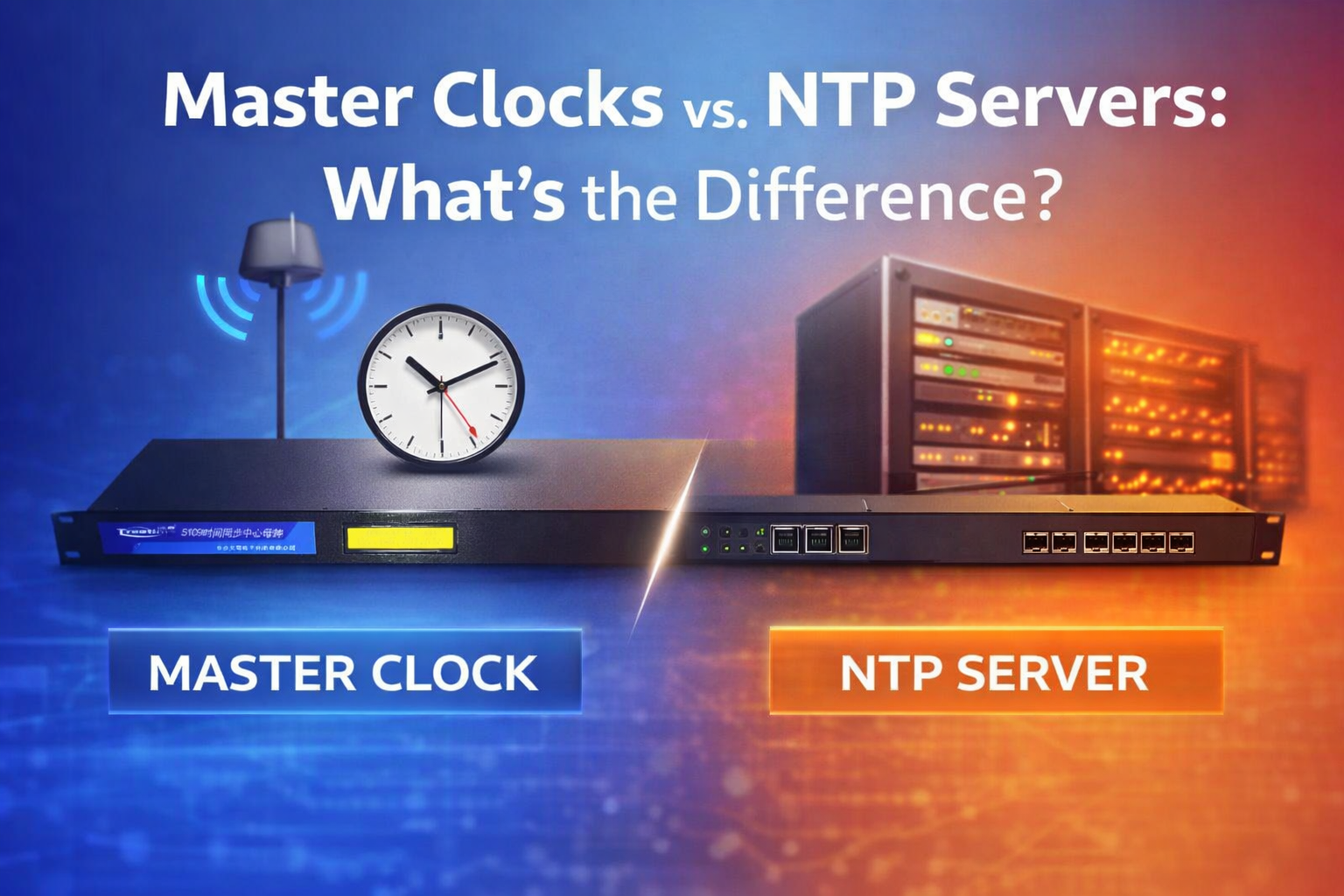
Rather than viewing these technologies as alternatives, it is more accurate to think of them as serving two different domains of time synchronization.
A master clock operates at the facility level, ensuring that physical devices and operational systems follow a unified schedule. It actively distributes time signals to clocks, controllers, and event-driven systems, often acting as the “heartbeat” of a building.
An NTP server, by contrast, operates at the network level, maintaining time consistency across digital systems. It passively responds to requests from network devices, allowing servers, computers, and applications toalign their internal clocks.
This distinction—active control vs. network-based reference—is one of the most important differences when selecting a solution.
One of the key ways to differentiate these systems is by how they interact with other components.
A master clock is designed to drive and control. It not only distributes time but can also trigger scheduled actions such as bells, lighting, or automated processes. This makes it ideal for environments where timing directly affects physical operations.
On the other hand, an NTP server is designed to standardize and align. It ensures that all connected devices share the same time reference, which is crucial for logging, system coordination, and cybersecurity. It does not control external systems—it simply provides accurate timestamps when requested.
In modern infrastructures, time synchronization is often layered.
At the top layer, a reliable time source (such as GPS or a trusted reference clock) establishes accuracy
In the middle layer, an NTP server distributes time across networked devices
At the operational layer, a master clock ensures synchronized execution of physical systems
This layered approach allows organizations to maintain both technical precision and operational coordination, instead of relying on a single method for all use cases.
Selecting between a master clock and an NTP server should be based on how time is used within your organization—not just the technology itself.
Your environment depends on synchronized physical systems, such as clocks, bells, or industrial processes. Facilities like hospitals, schools, and manufacturing plants benefit from the centralized control a master clock provides.
Your priority is maintaining consistent timestamps across IT systems, including servers, databases, and network devices. This is essential for data integrity, compliance, and system diagnostics.
Your organization operates across both physical and digital domains—which is increasingly the norm. In such cases, combining both solutions ensures that all systems, from wall clocks to servers, are aligned to the same accurate time source.
When evaluating solutions, consider these practical factors:
Scope of synchronization: Are you aligning people, machines, or data—or all three?
Accuracy source: GPS-based systems provide higher independence and precision
System resilience: Look for redundancy, such as backup time sources or failover capability
Integration needs: Ensure compatibility with existing infrastructure and protocols
Future scalability: Choose solutions that can expand with your facility or network
Master clocks and NTP servers are not competing technologies—they are complementary components of a complete time synchronization strategy. The real question is not which one is better, but how each fits into your operational and technical environment.
By understanding their distinct roles and planning accordingly, organizations can build a time system that is both accurate and resilient.
 Back to List

Customer Hotline: