A Trusted Grade III Class A Hospital Serving the Community
Founded in 1901 (the 27th year of the Guangxu reign of the Qing Dynasty), Kaiping Central Hospital has over a century of history and medical excellence. Today, it has developed into a Grade III Class A comprehensive hospital, integrating medical treatment, education, scientific research, healthcare, rehabilitation, and disease prevention.
The hospital has been recognized for many consecutive years as one of China’s Top 100 County-Level Comprehensive Hospitals and ranks among the Top 50 Hospitals in Guangdong Province. It is a demonstration unit of Guangdong’s “Four-Strength” Party Building Project, a supporting hospital of Sun Yat-sen University Cancer Center, a postgraduate training base for Jinan University and Guangzhou Medical University, and a collaborative hospital of Guangdong Provincial People’s Hospital.
In a complex hospital operating environment, accurate and unified time is critical across all scenarios—from outpatient queue management, operating room scheduling, nursing medication administration, and emergency resuscitation, to medical equipment data logging.
Following system deployment, Kaiping Central Hospital achieved significant improvements:
Unified Medical Time Standard
All hospital areas and systems now operate under a single, consistent time reference, forming a solid foundation for medical safety.
Enhanced Clinical Efficiency
Precise time synchronization enables smoother interdepartmental coordination, improving surgical scheduling and outpatient workflow efficiency.
Improved Medical Data Integrity
Accurate, legally compliant timestamps strengthen electronic medical records and medical order execution logs, enhancing quality management.
Better Patient Experience
Clear and accurate time displays reduce patient uncertainty and reflect the hospital’s modern, intelligent service image.
Intelligent, Low-Maintenance Management
Fully automated synchronization eliminates manual calibration, significantly reducing operational and maintenance costs.
The successful implementation at Kaiping Central Hospital demonstrates how Changsha Tianqiong Electronics effectively integrates precision timing technology with real-world medical requirements. By deploying a standardized, digital hospital clock system, the hospital has strengthened its time management infrastructure, improved operational efficiency, and enhanced patient safety.
This project marks another important step toward smart hospital development and precision-driven healthcare management, setting a strong benchmark for medical institutions seeking reliable and future-ready time synchronization solutions.
Prior to the project, Kaiping Central Hospital faced several challenges related to time management:
Difficult Clinical Coordination
Time discrepancies between departments and nurse stations affected shift handovers, surgical transitions, and the accuracy of medication administration.
Risks in Medical Data Recording
Inconsistent time between medical information systems, medical devices, and wall clocks posed potential risks to the accuracy and compliance of medical records and timestamps.
Patient Experience Gaps
Inaccurate or unclear time displays in waiting areas and wards caused confusion and anxiety among patients and their families.
Low Management Efficiency
Manual time calibration was labor-intensive and could not ensure real-time, hospital-wide synchronization

To address these challenges, Changsha Tianqiong Electronics deployed a hospital-wide time synchronization system centered on a GPS Satellite-Synchronized Master Clock.
A GPS-synchronized master clock was installed in the hospital’s central data center to serve as the single, authoritative time reference for the entire hospital.
Technical Advantages:
Automatically receives GPS satellite signals
Provides millisecond-level accuracy
Ensures an absolutely precise and reliable time baseline
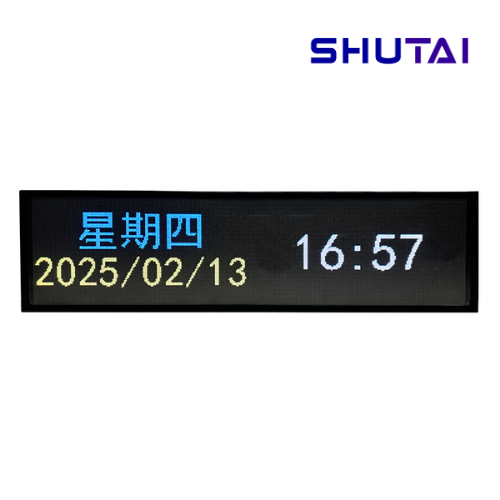
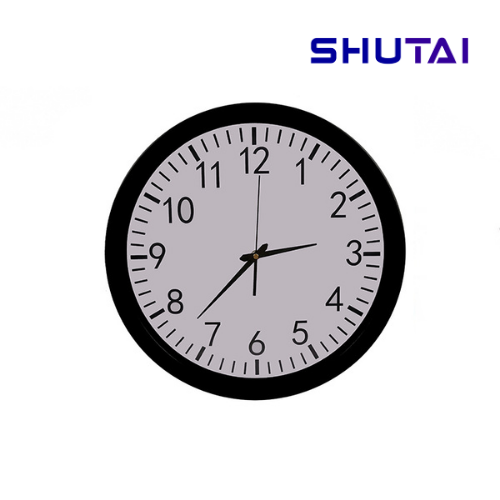
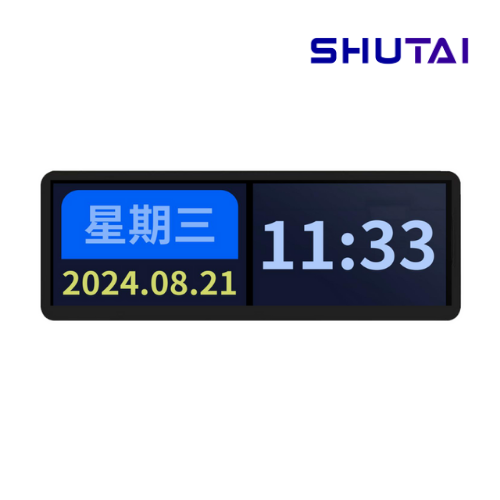
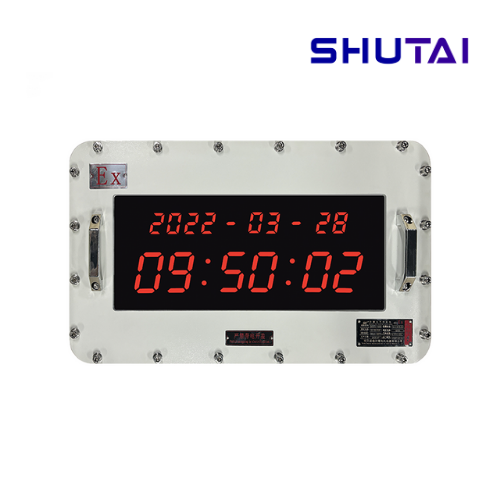
Customized digital clocks were deployed throughout the hospital to ensure clear, consistent time visibility.
Nurse Stations
High-clarity hospital digital clocks support accurate execution of medical orders and vital sign documentation, ensuring nursing efficiency and precision.
Corridors and Waiting Areas
Double-sided hospital clocks were installed in high-traffic public areas, allowing time visibility from multiple angles. This improves patient flow management and reduces waiting-related anxiety.
Inpatient Wards
Digital clocks in ward corridors and public spaces provide convenience for patients and visitors while supporting standardized ward management.
Critical Departments (Operating Rooms, Pharmacy, etc.)
Dedicated clocks ensure absolute time synchronization in high-risk, time-sensitive medical environments.
The master clock synchronizes automatically with hospital servers and workstations via the NTP protocol, including HIS (Hospital Information System) and PACS (Picture Archiving and Communication System).
All slave clocks (digital and double-sided clocks) receive time signals through wired or wireless networks, achieving second-level synchronization across the entire hospital.
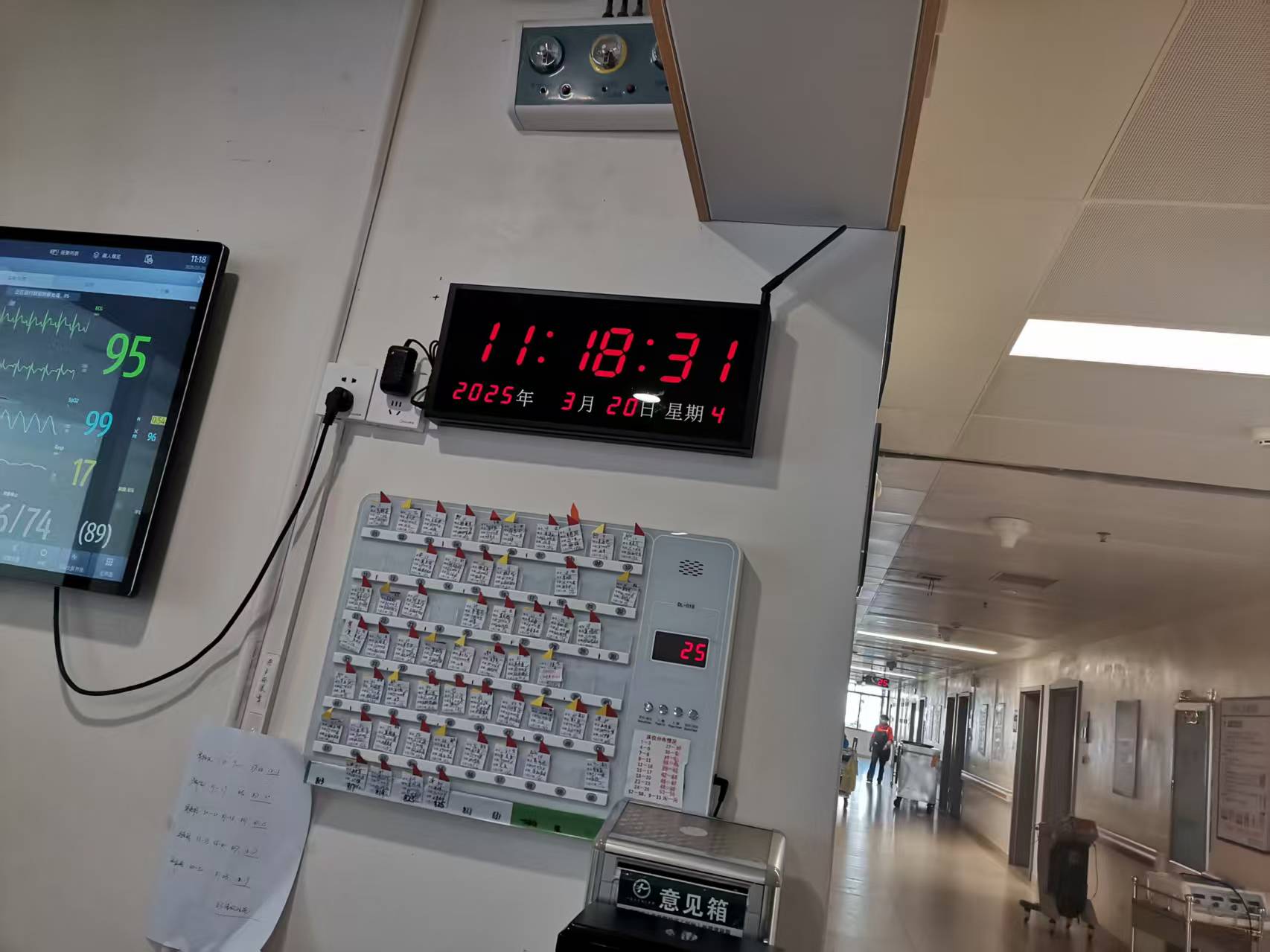
Following system deployment, Kaiping Central Hospital achieved significant improvements:
Unified Medical Time Standard
All hospital areas and systems now operate under a single, consistent time reference, forming a solid foundation for medical safety.
Enhanced Clinical Efficiency
Precise time synchronization enables smoother interdepartmental coordination, improving surgical scheduling and outpatient workflow efficiency.
Improved Medical Data Integrity
Accurate, legally compliant timestamps strengthen electronic medical records and medical order execution logs, enhancing quality management.
Better Patient Experience
Clear and accurate time displays reduce patient uncertainty and reflect the hospital’s modern, intelligent service image.
Intelligent, Low-Maintenance Management
Fully automated synchronization eliminates manual calibration, significantly reducing operational and maintenance costs.
The successful implementation at Kaiping Central Hospital demonstrates how Changsha Tianqiong Electronics effectively integrates precision timing technology with real-world medical requirements. By deploying a standardized, digital hospital clock system, the hospital has strengthened its time management infrastructure, improved operational efficiency, and enhanced patient safety.
This project marks another important step toward smart hospital development and precision-driven healthcare management, setting a strong benchmark for medical institutions seeking reliable and future-ready time synchronization solutions.
 Back to List

Customer Hotline: