The Shutai Airport clock system is designed in accordance with the MHT5019-2014 Engineering Design Specification for Civil Airport Terminal Clock Systems.
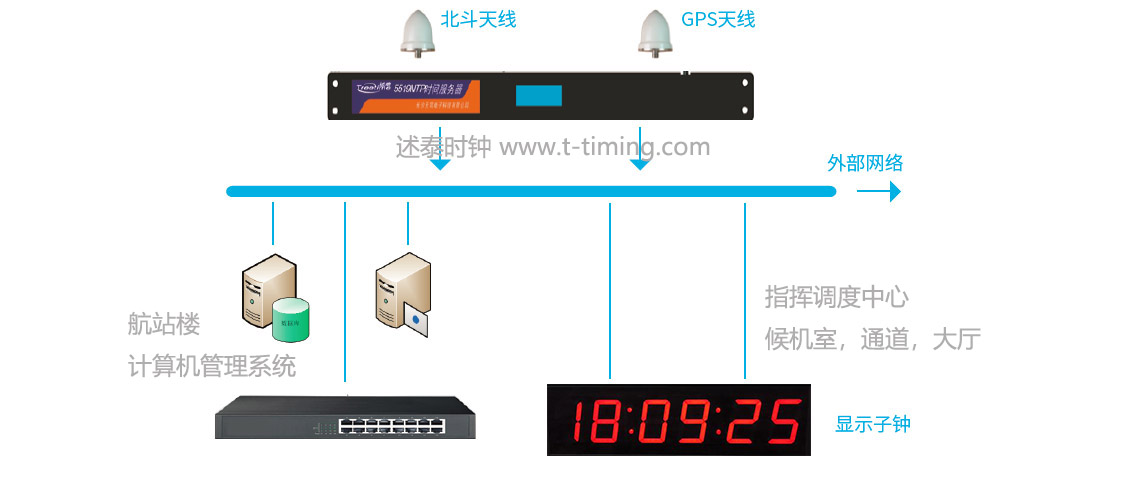
The Shutai clock system primarily provides the airport with a unified time standard. Utilising the time reference signal from the BeiDou/GPS satellite navigation positioning system as the standard time source, the system corrects the master clock time and provides time synchronisation services to subsidiary clocks throughout the terminal building and computers within the local area network.
Specialised Terminology Explanation
1. Master Clock: A device that receives navigation satellite signals to obtain standard time information, undergoes local correction and maintenance, then transmits time signals to its subordinate subsystems.
2. Slave Clock: A device that receives signals transmitted by the master clock to display time.
3. GPS Clock Signal: Greenwich Mean Time signals transmitted by the Global Positioning System.
General Provisions
Master Clock: TQ5109 NTP Server
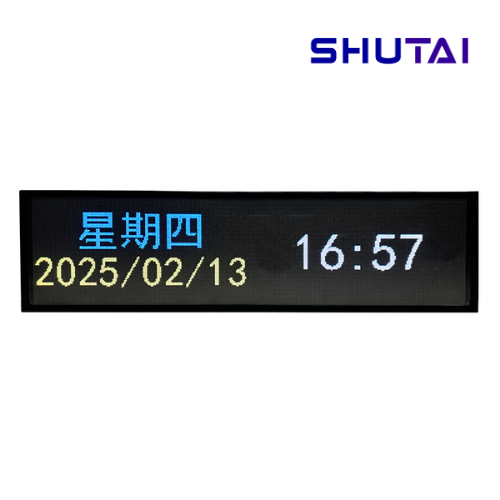
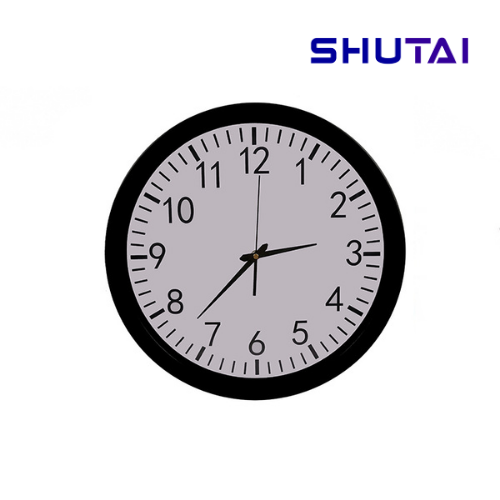
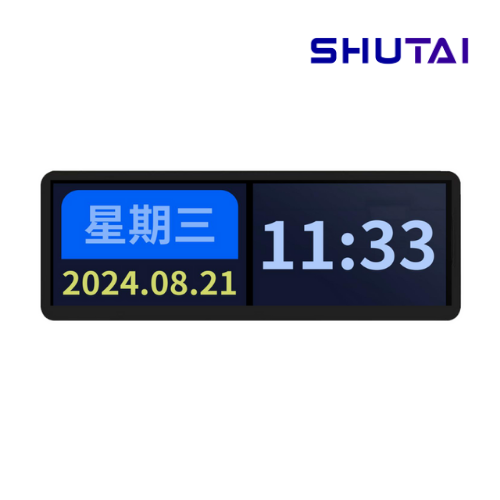
Slave Clock: DH2682 NTP Slave Clock, R14W Dial Clock
a. The clock system in common civil airport terminals shall provide accurate and unified time services for airport staff, passengers, and computer management systems.
b. Standard mother-daughter clock systems displaying Beijing Time suffice for most airports. Airports handling international flights should additionally install world clocks displaying local times for relevant cities.
The master clock typically employs BeiDou/GPS satellite timing acquisition. After obtaining time, it synchronises slave clocks via NTP protocol or RS485 bus.
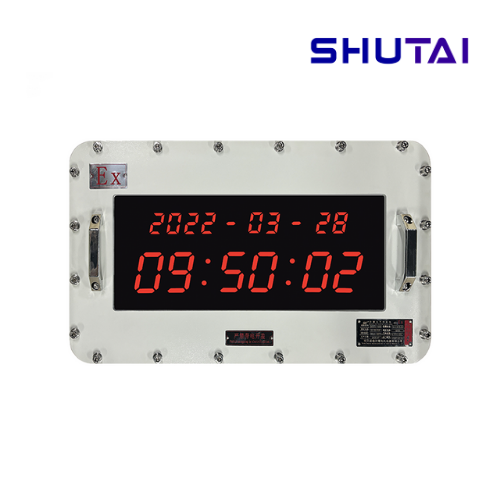
Slave clocks are categorised as single-faced or double-faced. Single-faced clocks may be analogue or digital. Double-faced clocks should preferably be digital. The display content for all sub-clocks may be determined according to practical requirements, but should at minimum show hours, minutes, and seconds. Digital clocks should incorporate anti-glare treatment to ensure optimal visibility.
Time monitoring software operates on a local area network computer, enabling administrators to view the operational status of master and sub-clocks and monitor the online status of sub-clocks.
Sub-clock installation locations
1. Sub-clocks should be installed in the command and dispatch centre, broadcast room, conference rooms, aeronautical meteorological information room, crew dispatch room, and other locations with special time requirements.
2. Sub-clocks should be installed in flight information display rooms and other equipment rooms with special time requirements.
3. Sub-clocks should be installed in prominent locations within the terminal building, such as passenger arrival/departure areas, waiting zones, check-in counters, and passageways. They should also be installed in passenger restaurants and rest areas.
4. Sub-clocks should be installed in baggage sorting and collection halls.
5. Where flight information display systems synchronise with a master clock, the installation of slave clocks should be minimised or eliminated in areas equipped with time-displaying flight information terminals.
Slave clock specifications shall be determined by installation height and viewing distance. Installation height is typically 2.5m to 5m above ground level, with adjustments permitted for special circumstances while maintaining aesthetic and functional requirements.
Power Supply Requirements
a. Power for master and slave clocks is typically supplied from the system's electronic equipment room. Where distances are considerable, a nearby reliable power source may be used.
b. Power voltage for master clock systems and slave/master clock equipment should generally comply with device specifications. When elevating the master clock's output signal voltage, ensure both the master clock's operating voltage and the signal current per circuit remain within permissible limits.
Airport terminal clock systems may be deployed in significant public buildings such as stations, universities, transport junctions, and landmark structures, as well as for time signalling in mobile and fixed telephony within the telecommunications sector. They furnish precise public timekeeping, facilitating daily life and mitigating inconveniences arising from inaccurate timepieces.

Customer Hotline:
 Free Customization Consultation